5 min read

Executive Isolation & AI Delusion: When the Machine Becomes the CEO's Right Hand

Every CEO needs an anchor. Someone who absorbs some of the pressure, prepares difficult decisions, challenges assumptions, and says the thing nobody else in the room wants to say. For decades, that role belonged to the co-founders, the chiefs of staff, the C-suite, the senior advisors, and the board of directors. They carried institutional memory, introduced friction, and forced leaders to confront reality before reality confronted the business.

Now, for many founders and executives, AI is beginning to mirror that role. It has quietly evolved from a productivity tool into an essential environment for thinking, planning, and decision-making.

This shift is creating a new distortion in executive judgment. CEO AI delusion describes a gradual tendency among founders and executives to confuse what AI can produce with what human organizations are still required to build, operate, and sustain. AI makes progress immediate and tangible: the code runs, the reports are insightful, and the implementation plans are well-constructed. The more convincing the outputs, the easier it is to mistake what AI produces for what an organization can actually deliver.

Key takeaways

  • AI can amplify output faster than organizations build judgment.
  • Founders and CEOs need real friction to prevent biased decision-making.
  • AI-generated insights are becoming increasingly sophisticated, yet quietly disconnected from reality.
  • Leaders must focus on preparing their people for the future rather than reducing headcount.
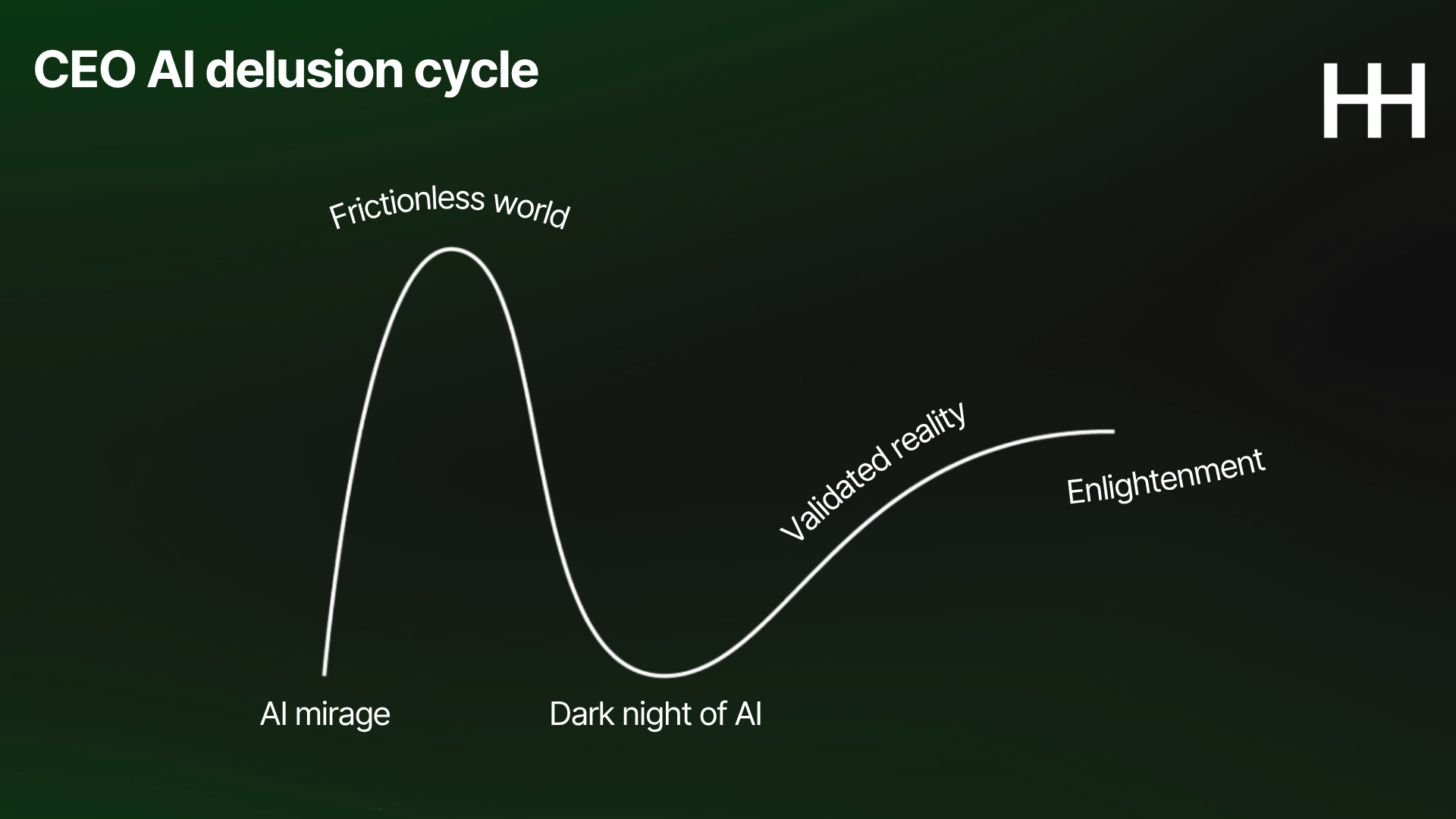
CEO AI delusion cycle
hh-gartner-hype-cycle-ai
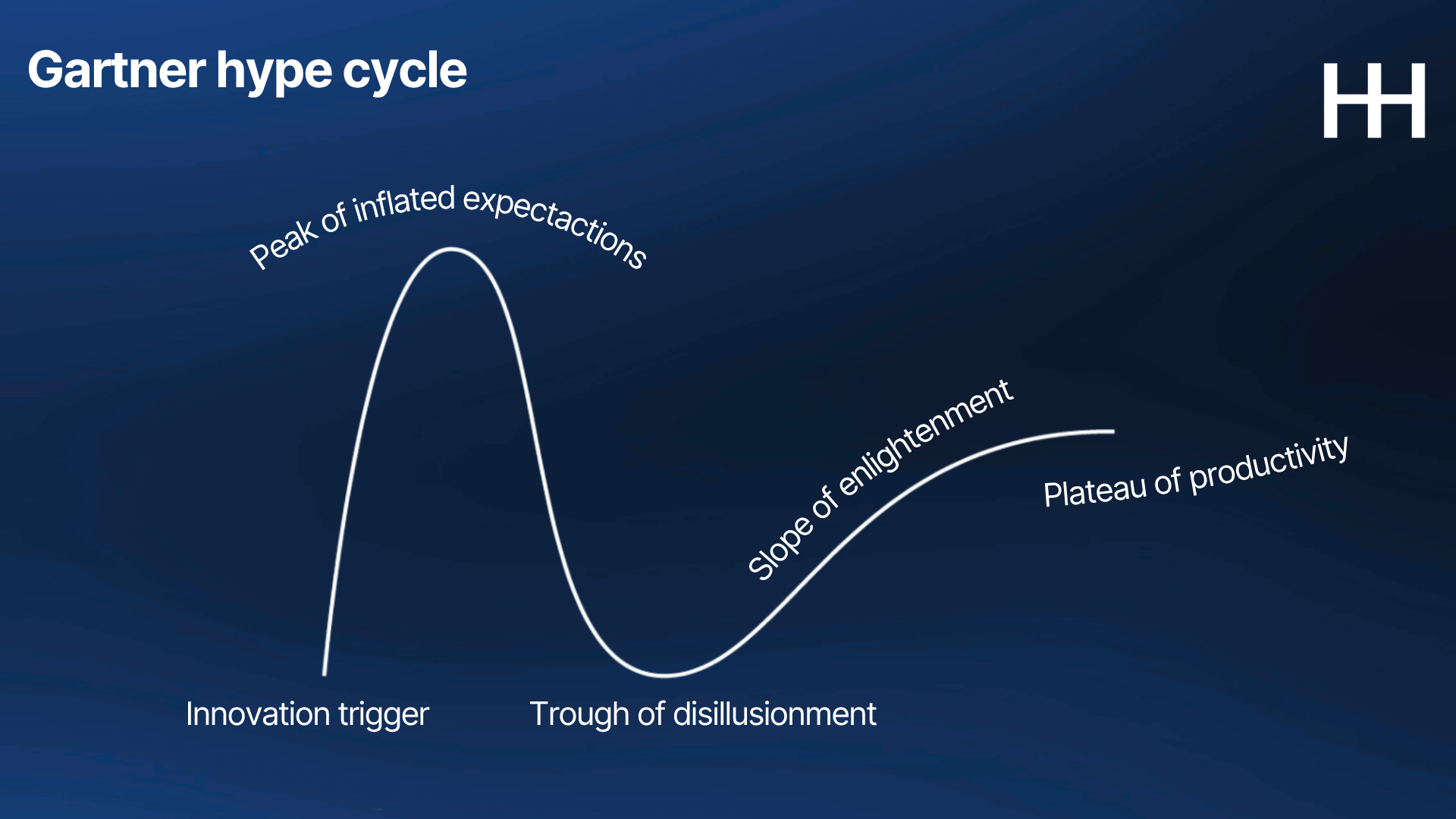
The AI-dependent CEO seems to go through a cycle not unlike the Gartner Hype Cycle.

The symptoms of infinite output

The shift develops incrementally, with every successful interaction making the next shortcut feel a little more reasonable. When a CEO presents a strategy to a human team, they encounter necessary friction and debate. When they bring that same strategy to an AI, the system simply generates a structured implementation plan, often without challenging the assumptions behind it.

For a leader under pressure, this absence of pushback can be easily mistaken for efficiency.

With AI-dependent leaders on the rise, a new pattern has emerged:

  • A founder stops investing in operational infrastructure because AI makes the company appear easier to run. Processes become prompts, managers become unnecessary, and coordination becomes an afterthought. Then growth arrives, and the organization begins breaking under the systems it never fully built.
  • A team of five now produces what once required fifty. Every efficiency metric improves, but the team eventually discovers that their ability to produce has outpaced their ability to operate.
  • A founder develops more software in one month than their engineering team shipped the previous year. Productivity looks extraordinary, but the company doesn’t quite know what it delivers, and in a perverse twist of fate, the first customers expose architectural problems that speed never solved.
  • A CEO stops scheduling customer interviews because AI can generate market analyses, competitor research, and buyer personas in minutes. Strategy becomes increasingly sophisticated, yet quietly disconnected from reality.
  • Executives begin replacing specialists with prompts. AI-generated legal documents, pricing strategies, hiring plans, product roadmaps — all become "good enough." Months later, the company realizes it scaled deliverables much faster than it scaled expertise.
  • A founder uses AI to turn uncertain ideas into confident capital-raising narratives. Chasing the AI hype cycle, raising funds becomes easier than building the organization capable of delivering the story.

None of these shortcuts feel reckless in isolation; that is what makes the pattern so difficult to see.

The isolation problem

As companies scale, executives become increasingly insulated from reality. Fewer people challenge their assumptions or deliver uncomfortable feedback.

This phenomenon, known as organizational silence, has been extensively documented in organizational research. As information moves upward, employees become less likely to voice concerns, leaving senior leaders with an increasingly filtered view of reality.

In that environment, AI can quickly become the default way to fill the gap. It is always available, completely private, and free from the discomfort of disagreement. It provides answers without hesitation and feedback without consequence.

Behavioral research suggests another risk emerging when decision-makers rely heavily on algorithmic advice: automation bias, the tendency to defer to machine-generated recommendations, particularly when they appear objective or authoritative. While generative AI is not making decisions on a CEO's behalf, its speed, confidence, and apparent completeness could make its outputs persuasive enough to go unchallenged.

Over time, the convenience of that relationship can begin to resemble the role once played by human advisors, operators, and peers. Like a mirage in the desert, appearances can be deceptive.

Isolated CEO

The frictionless machine

One of AI's greatest strengths is its responsiveness. It takes an idea and immediately transforms it into something useful.

The problem is that friction disappears from the process.

Organizations generate friction because people have different incentives, different expertise, and different perspectives. A CTO questions technical assumptions. A CFO challenges financial projections. A head of sales explains why customers won't behave the way the strategy predicts. It is not a flaw.

These conversations might feel inefficient because they delay decisions, complicate meetings, and create uncertainty. But they also prevent expensive mistakes.

The companies struggling to capture AI's value often confuse access to AI with the organizational judgment required to apply it effectively.

According to McKinsey’s 2025 research on the state of AI, while generative AI adoption has soared, with 88% of organizations now regularly using it, actual enterprise-level impact remains incredibly rare. In fact, only 6% of companies qualify as high performers capturing significant financial value from it (reporting an EBIT impact of 5% or more). Similarly, studies from MIT tracking AI in the workplace reveal a clear boundary: AI drastically improves speed and performance on bounded, structured tasks, but it fundamentally struggles with complex, systemic problem-solving.

Founders and CEOs experiencing AI delusion often ignore this frontier, assuming that since an AI can create a high-quality presentation or quickly enrich a database, it can also replace the expertise required to make difficult decisions.

AI-assisted success

When scoped correctly by someone with deep domain expertise, the potency of AI is undeniable. Pieter Levels' multi-million-dollar Photo AI is a useful example. Levels built the product as a solo founder, using AI tools to accelerate development while maintaining responsibility for architecture and product decisions. He already understood software development, product iteration, and the constraints of building online businesses. AI increased his speed; it did not replace the expertise required to know what to build, what to fix, and what to ignore.

AI-assisted disaster

In 2023, the National Eating Disorders Association (NEDA) laid off its human helpline staff and transitioned to an AI chatbot. The deployment was a catastrophic failure. Within days, public reports revealed the AI was giving highly vulnerable individuals harmful advice, and NEDA was forced to suspend the chatbot entirely.

A similar pattern emerged in the case of Builder.ai, a startup that reached a multibillion-dollar valuation by positioning its platform as an AI-powered way to build software with dramatically less human involvement. As scrutiny increased, reports revealed that much of the software development process still depended on large teams of human engineers behind the scenes. The gap between the product's promise and the operational reality exposed a recurring pattern: AI can accelerate the production of software, but it cannot eliminate the expertise required to build and maintain complex systems indefinitely.

AI as a substitute vs. AI as an accelerator

The distinction between models is subtle, but it determines whether AI strengthens an organization or masks the capabilities required to sustain it.

AI as a substitute AI as an accelerator
Replace specialists Build up specialists
Automate judgment Accelerate execution
Reduce headcount Develop specialized expertise
Rely on prompt engineering Build new core capabilities
Produce more outputs Make better decisions
Scale faster Compound expertise

The companies that will outlast the hype

AI creates the illusion that one founder can now produce the output of an entire organization. Much of that productivity gain is real. The mistake is assuming the organization is no longer necessary.

The companies that outlast the hype cycle will understand where AI creates speed and where human capability remains the source of advantage. That approach comes down to a few deliberate choices:

  • Double down on the people who actually run the business. Algorithms absorb the sheer volume of daily production, while leaders focus on equipping their teams to navigate the complex, unscripted realities of a growing enterprise.
  • Shift the focus from quickly generating strategy to validating reality. An AI can instantly draft a comprehensive market expansion plan, but leaders must rigorously review and test those assumptions before an additional dollar of capital is deployed.
  • Keep founders in the room with customers, where reality is still discovered through conversation, alignment, and judgment.
  • Develop specialists who know when an AI answer is useful, when it is incomplete, and when it is dangerously wrong.
  • Build organizations that become smarter with every decision, every hire, and every customer they serve.

Companies like Canva and Miro are already showing what AI-accelerated organizational success looks like in practice. They use AI to expand the capabilities of specialized teams while preserving the judgment, expertise, and collaboration required to turn outputs into meaningful results.

As AI continues making production cheaper, the temptation to mistake outputs for organizations will only grow stronger. The companies that resist that temptation may quietly become the strongest businesses of the AI era.

Surviving the frictionless machine ultimately means breaking the executive echo chamber — demanding to leave the quiet comfort of algorithmic agreement to stand alongside the people who have the courage and expertise to challenge assumptions and pull strategy back into reality.

Henna Haroon & Associates Expands Aviation Practice, Adding Former Airline Executives to Lead Strategic Operations

1 min read

Henna Haroon & Associates Expands Aviation Practice, Adding Former Airline Executives to Lead Strategic Operations

Henna Haroon & Associates (HH&A), the global strategic advisory and execution firm, today announced from its European hub in Dublin that former...


Read More
From Founder Voice to Strategic Branding

1 min read

From Founder Voice to Strategic Branding

In the early stages, the market trusts the mind behind the business. The story is coherent because it comes from one place. Then growth changes the...

Read More
The Everything Burger Is a Nothing Burger

1 min read

The Everything Burger Is a Nothing Burger

There’s a growing trend I’ve been watching in the age of AI agents and all-in-one SaaS products: the rise of the digital everythingburger. You've...

Read More